Starting formula
Bagels
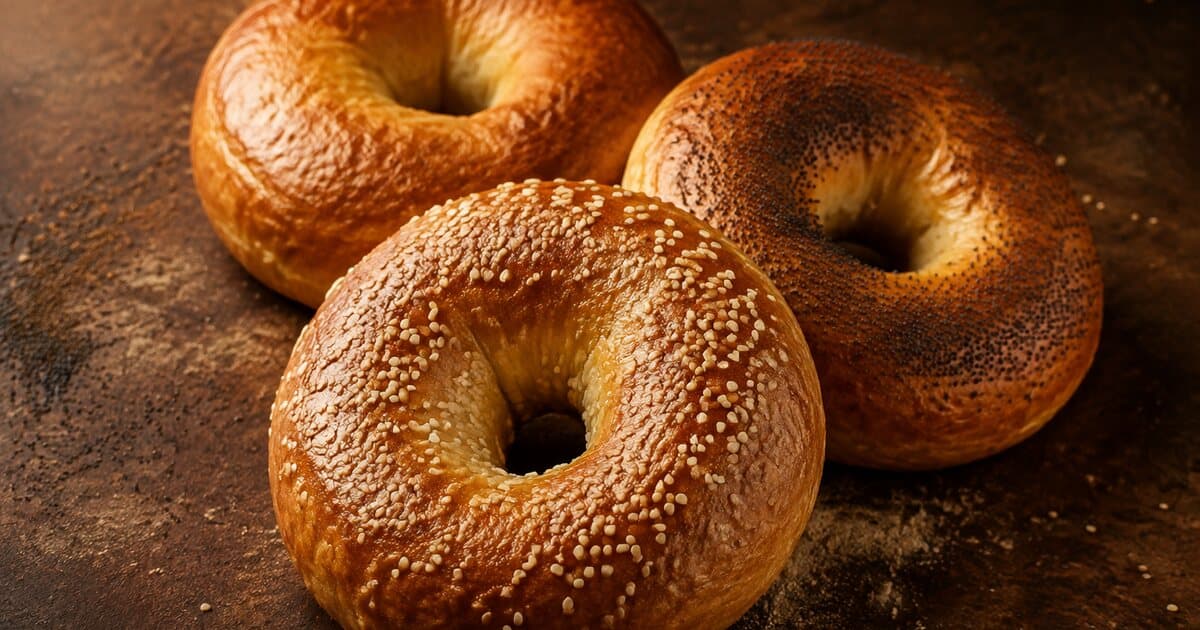
Firm dough. Glossy crust. Proper chew.
Bagels need much firmer dough than bread or pizza. This formula starts with eight equal bagels and scales without mental arithmetic.
The formula
Eight chewy bagels
Starting point: eight equal bagels. Change the count or piece weight in the calculator.Active preparation: about 35 min · Boiling and baking: about 30 min. Proofing time varies.
- Flour
- 100%571.5 g
- Water
- 55%314.3 g
- Salt
- 2%11.4 g
- Yeast
- 1%5.7 g
- Sugar
- 3%17.1 g
Firm dough that holds its shape
Low hydration creates the characteristic close crumb and firm chew. It is also why kneading feels rather more like work.Hydration
Firm, shapeable dough with a close crumb.
Equal pieces
A generous starting size, scaled precisely in the calculator.
Sugar
Supports browning and adds a mild sweet background.
Why bagel dough should be firm
Less water limits crumb openness and makes tight rings possible. Boiling then sets the surface before the oven expands and browns the bagel.
This formula uses sugar as a practical dough ingredient. For a more classic profile you can replace some with malt syrup or honey, but account for liquid sweeteners when precision matters.
From stiff dough to glossy bagels
These steps are for the standard batch of 8 bagels at 115 g each. Allow about 2½–3 hours from mixing to cooling.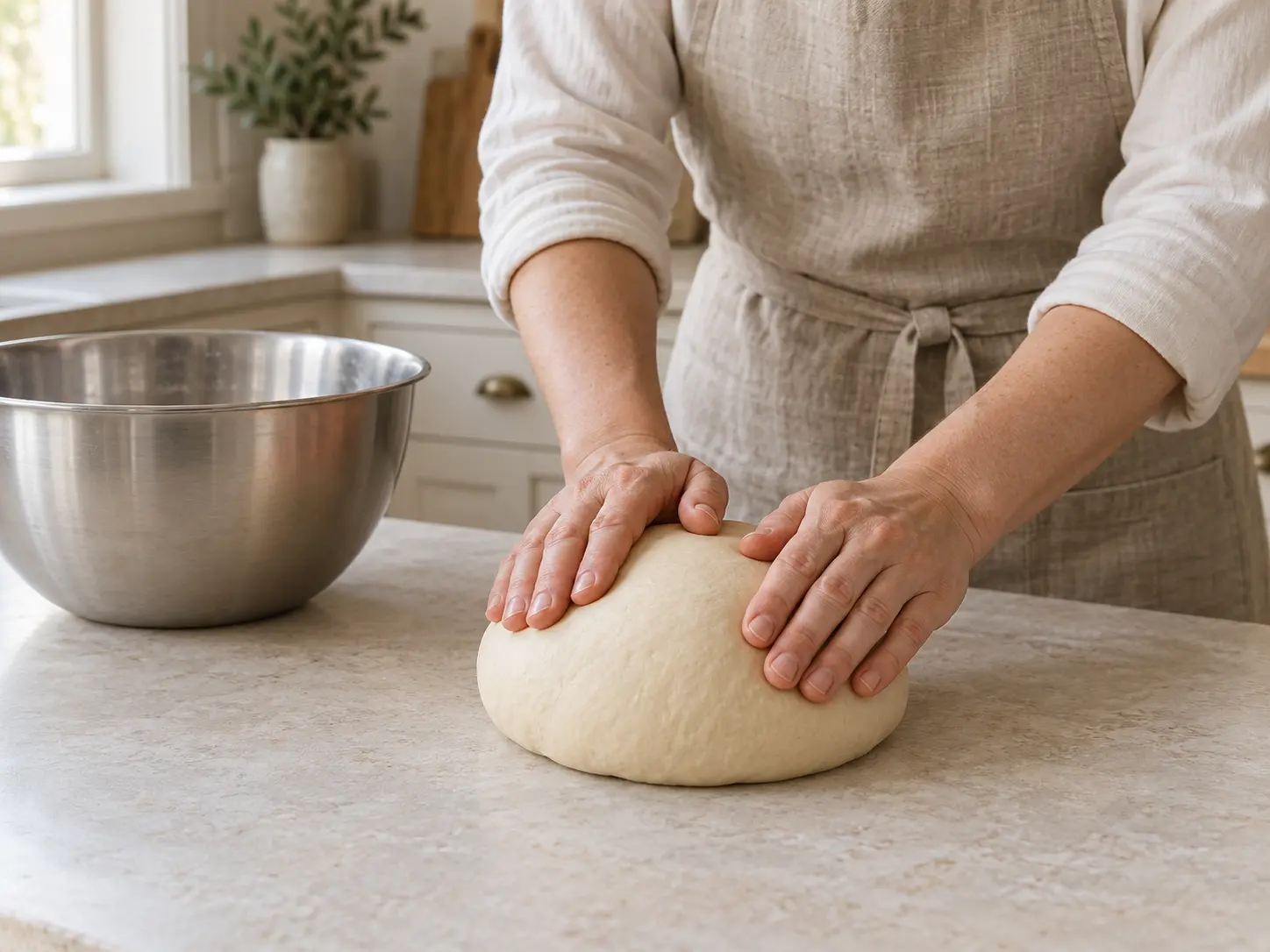
Knead until firm and smooth
Use 571 g strong bread flour, 314 g cool water, 17.1 g sugar, 5.7 g instant yeast and 11.4 g salt. Stir the sugar and yeast into the water, add the flour and mix until no dry patches remain. Add the salt. Knead for 10–12 minutes on the lowest mixer speed or about 15 minutes by hand; if the dough resists strongly, rest it for 5 minutes halfway through. It should remain noticeably firmer than bread dough but form one smooth, cohesive ball. Aim for 23–25 °C.
At 55% hydration the dough feels stiff, but it should still form one smooth ball without dry cracks.
Divide and let relax
Divide the dough immediately into 8 pieces of 115 g and round each piece tightly. Keep the balls covered so they do not form a skin and rest them for 10 minutes. This short rest relaxes the gluten and stops the ropes from shrinking back as you roll them.
Shape the rings
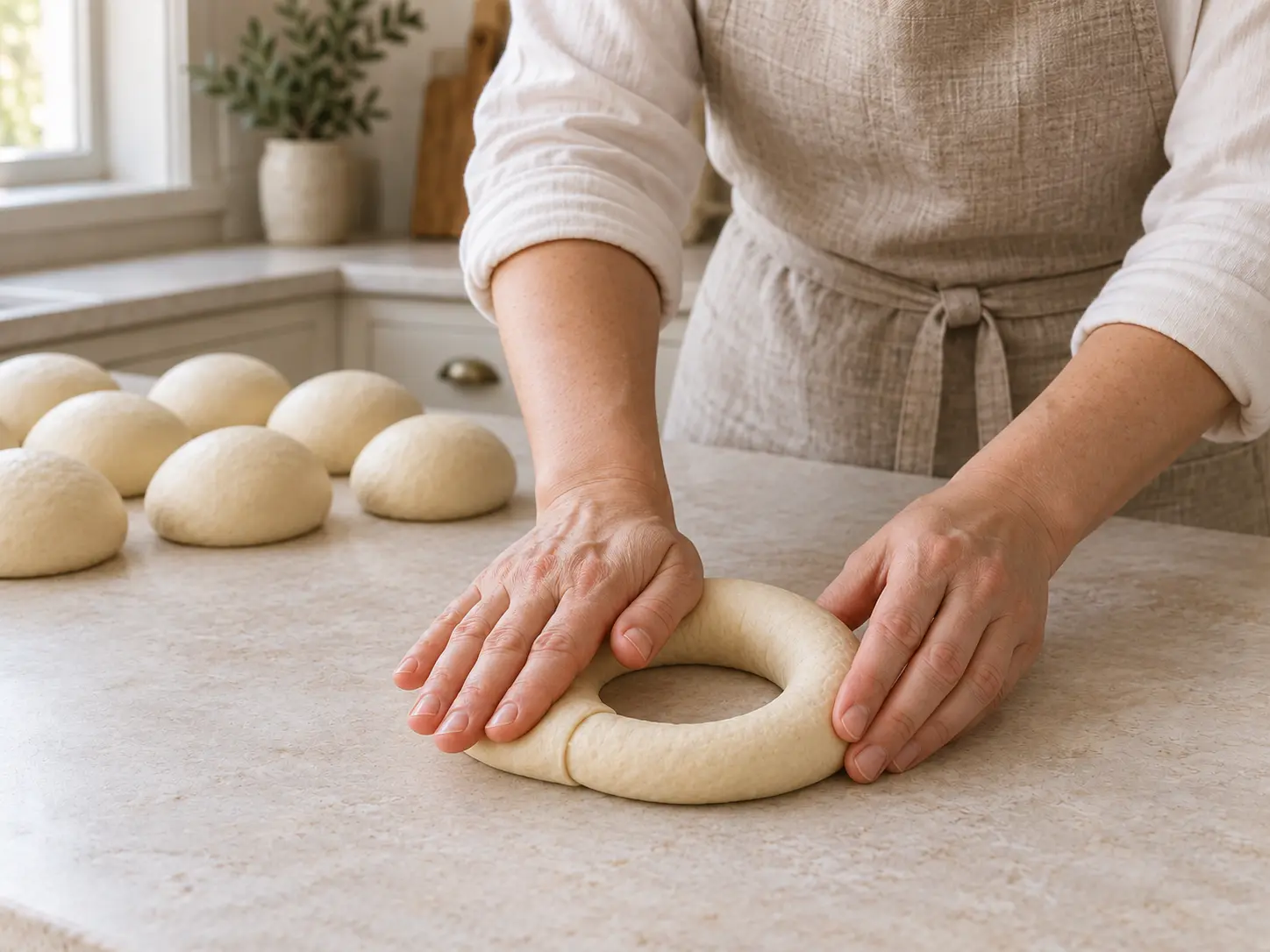
With very little flour, roll each ball into a 24–26 cm rope. Wrap it around your hand, overlap the ends by 4 cm, moisten the join very lightly and roll the seam firmly beneath your palm. Leave a 4–5 cm centre hole; it will shrink during proofing and boiling. If a rope springs back strongly, cover it and wait another 5 minutes.
Overlap the ends by 4 cm and keep the centre hole 4–5 cm wide; both contract during boiling.
Proof briefly and chill
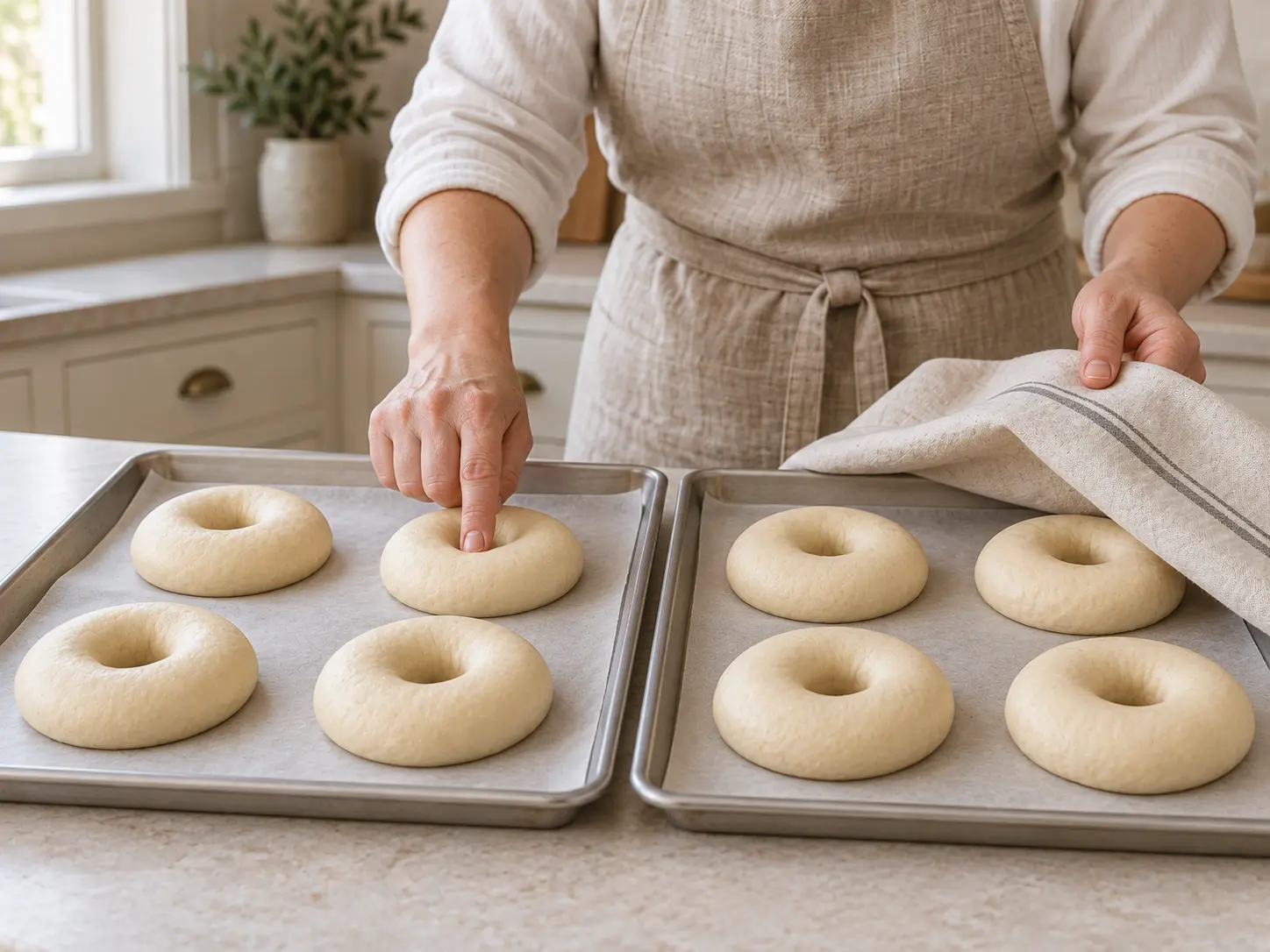
Place the rings on two parchment-lined trays and cover loosely. Proof for 30–45 minutes at 22–24 °C, until visibly a little fuller but nowhere near doubled. A light finger press should return slowly most of the way. Refrigerate for 20–30 minutes so the rings stay firm during boiling. Meanwhile, preheat the oven to 220 °C conventional heat.
Stop proofing when the rings are slightly fuller but still firm; they should not double.
Boil and top
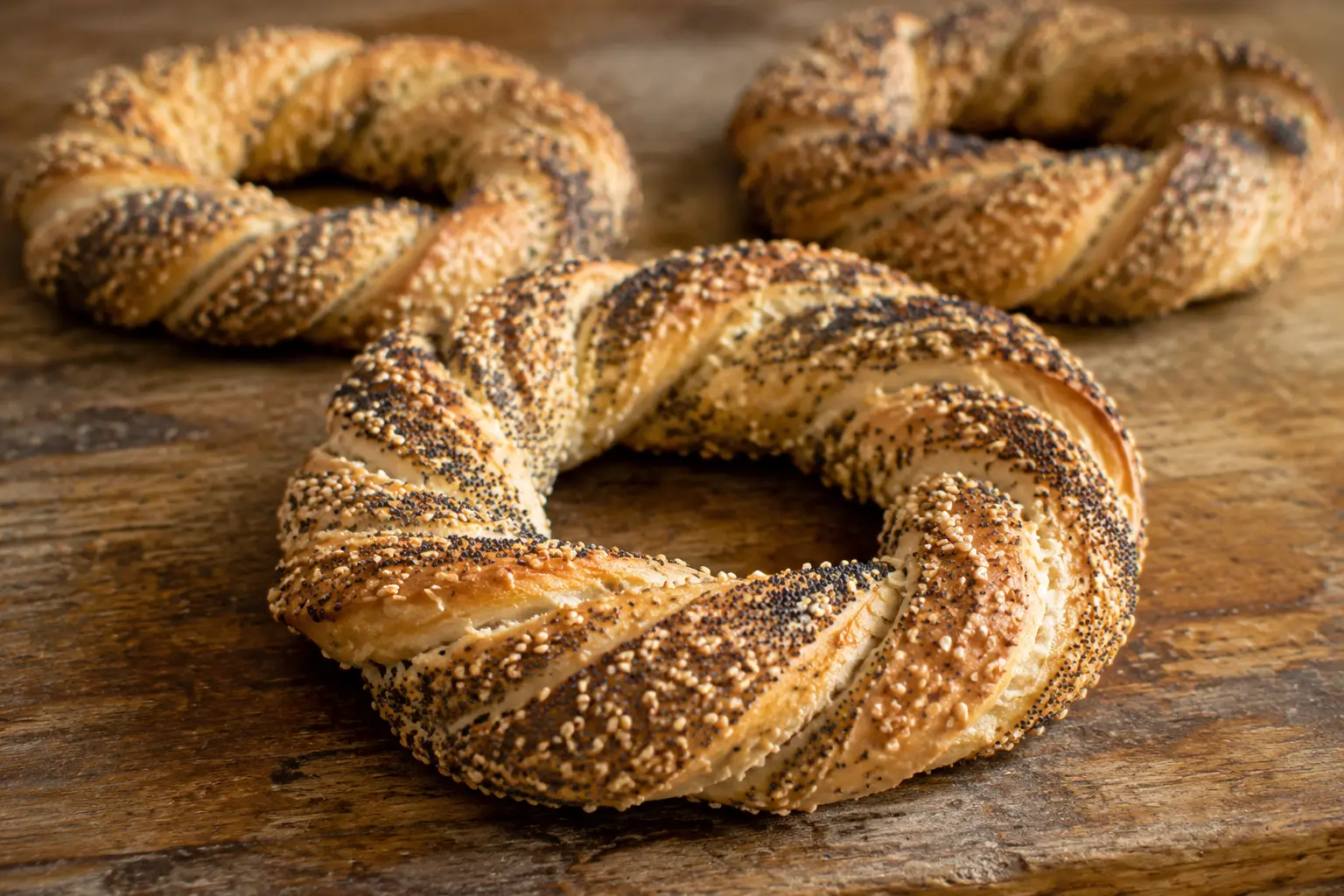
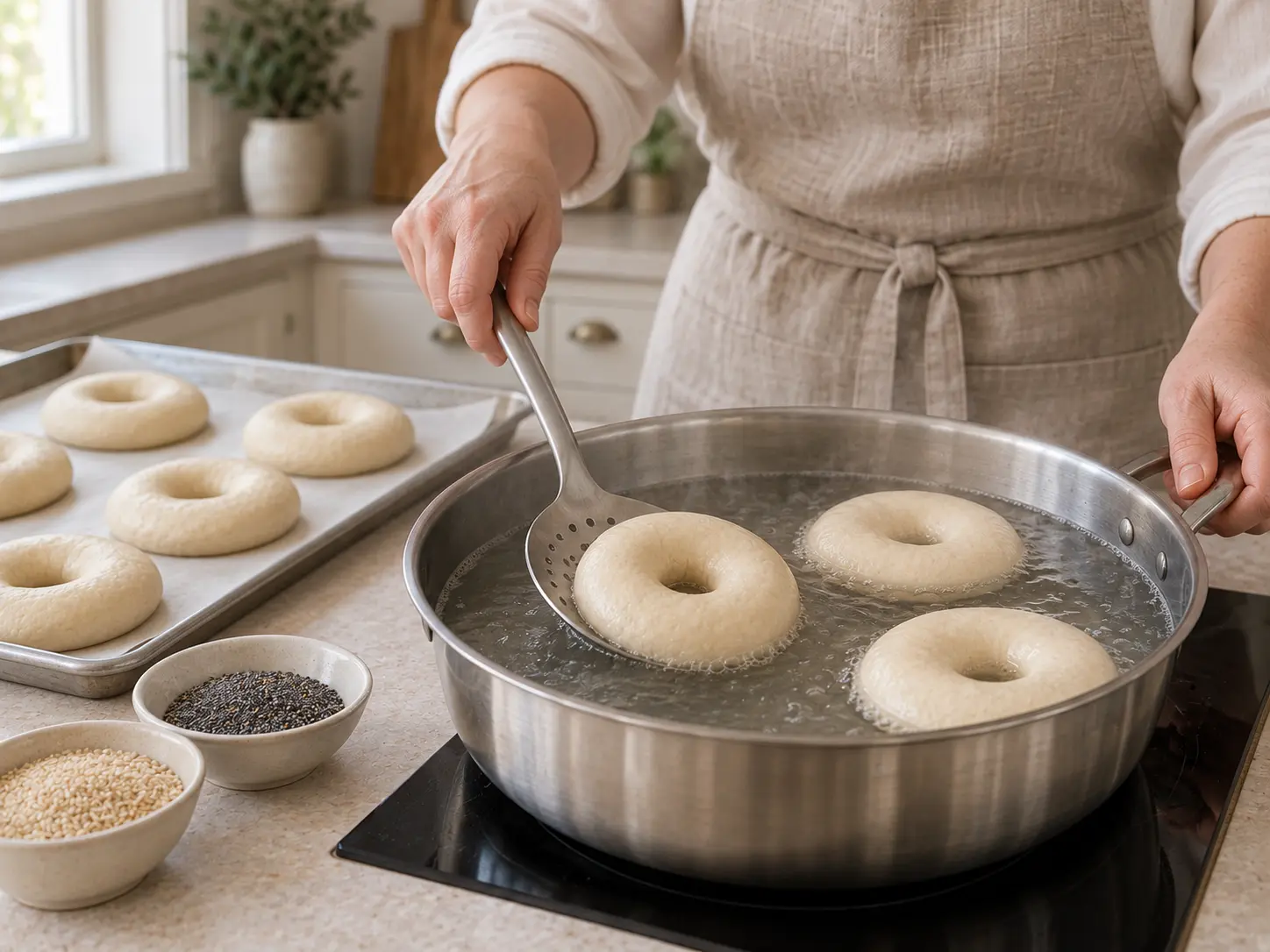
Bring 3 litres of water with 30 g sugar or honey and 5 g baking soda to a very gentle boil in a wide pan. Boil 2–3 bagels at a time for 30 seconds, turn carefully and boil the other side for 30 seconds. Drain for 10 seconds with a slotted spoon, return to parchment and add sesame, poppy seed or another topping while the surface is still wet.
Boil 2–3 at a time for exactly 30 seconds per side and add the topping immediately while the surface is wet.
Bake until deeply golden
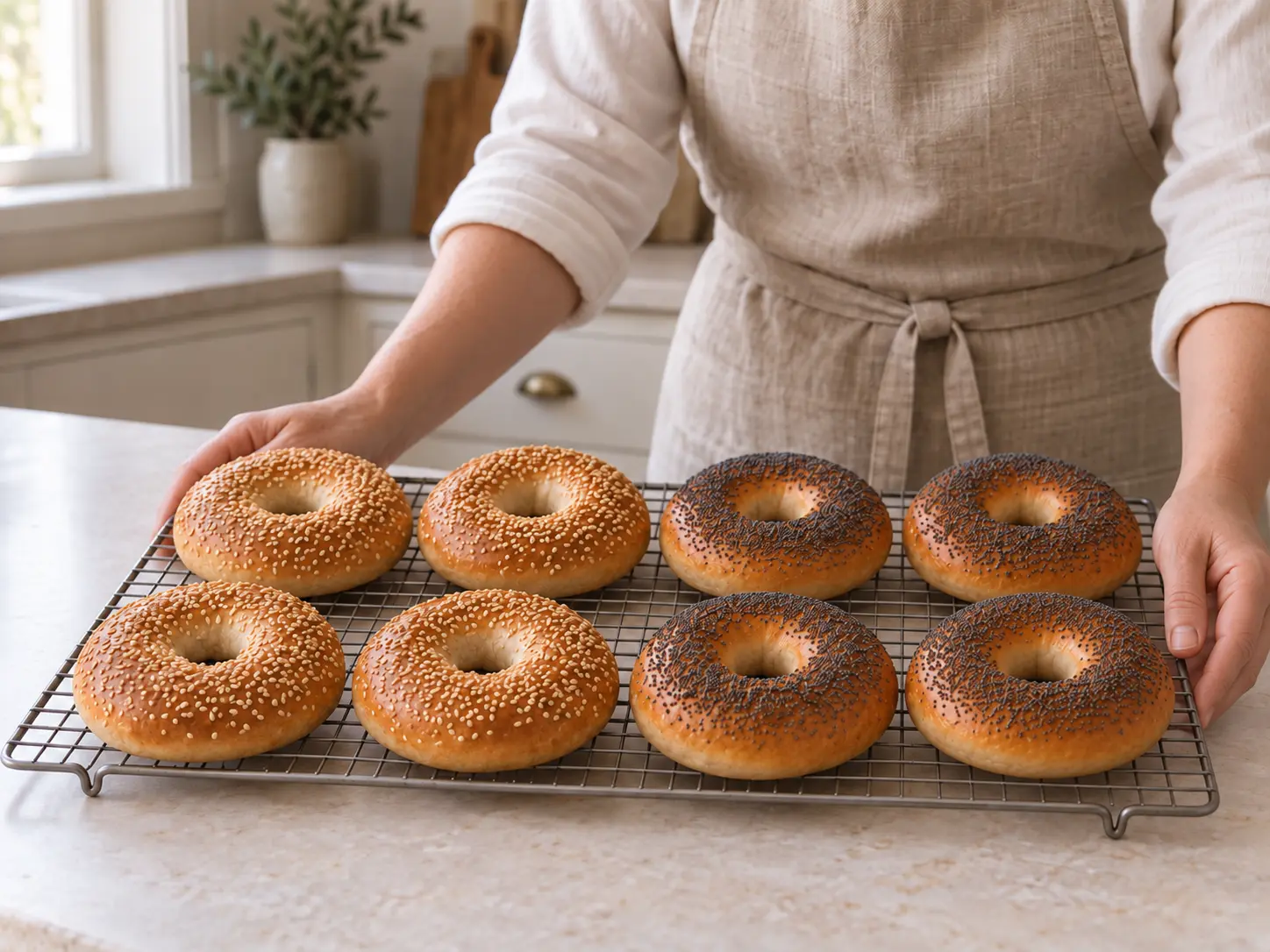
Bake the bagels immediately for 20–24 minutes at 220 °C conventional heat. They are ready when the crust is deeply golden and lightly glossy and the underside feels firm. Swap two trays after 12 minutes if your oven bakes unevenly. Transfer the bagels to a wire rack and cool for at least 30 minutes before slicing.
The crust is deeply golden and lightly glossy; cool the bagels on a wire rack for at least 30 minutes.
Problems with shape, crust or crumb
The seam opens
Moisten the ends lightly and roll the join firmly beneath your palm.
They collapse after boiling
Shorten the proof; overproofed bagels lack strength when they hit the water.
The crust stays dull
Use a mildly alkaline boiling bath and drain the bagels well before baking.
Frequently asked questions
Do bagels always need boiling?
For the characteristic glossy, firm crust, yes. Without boiling you mainly have bread rolls with a hole.
Can the dough chill overnight?
Yes. Chilling develops flavor and makes timing easier. Reduce the yeast if needed.
Why is this dough so hard to knead?
A 55% hydration is deliberately low. Give the dough short rests and do not force a light-duty mixer.