Baker's percentages explained
One simple ratio for every dough.
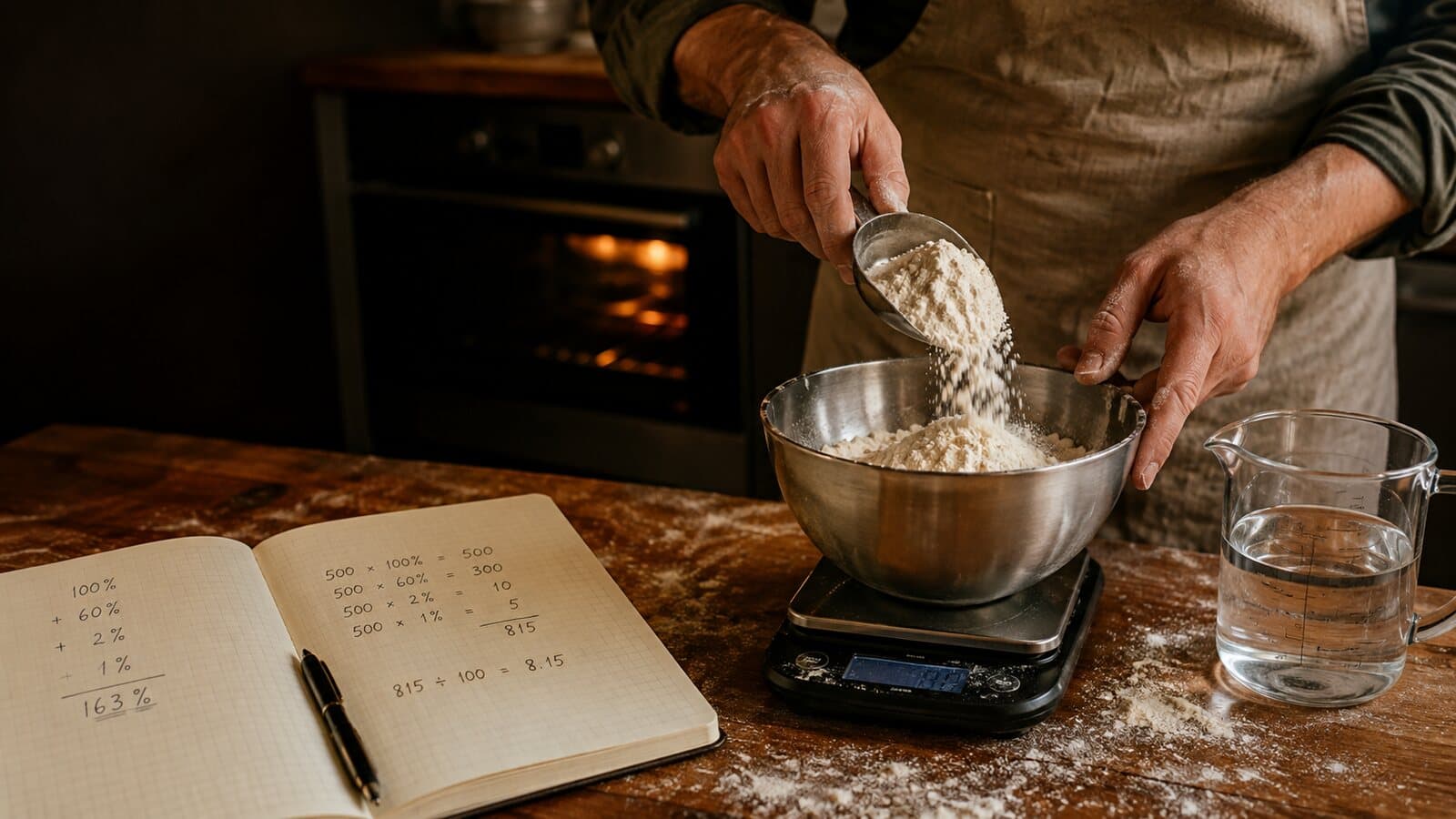
In baker's percentages, all flour together is always 100%. Water, salt, yeast and other ingredients are expressed as percentages of that flour. This lets you scale and compare recipes without starting the arithmetic again.
Calculate my doughFlour is the fixed starting point
An ordinary percentage is often a share of the total. Baker's percentages work differently: total flour weight is always 100%. Every other ingredient is compared with that flour weight.
Using 400 grams of flour and 260 grams of water gives 260 ÷ 400 × 100 = 65% hydration. Whether you make one loaf or twenty, that relationship stays the same.
Step by step
Calculating from 400 grams of flour
You have 400 grams of flour and want a supple basic dough with 65% water, 2% salt and 0.5% yeast. Multiply each percentage by the flour weight.
- Water
400 × 0.65260 g - Salt
400 × 0.028 g - Yeast
400 × 0.0052 g
Add flour, water, salt and yeast and you get 670 grams of dough. In the calculator, simply choose ‘I have flour’. The calculator handles the rest.
Why bakers use this method
Scale with confidence
Go from one pizza ball to twelve without changing the formula.
Compare recipes
See which dough is drier, saltier or richer even when the batch sizes differ.
Adjust deliberately
For a wetter dough, change the water percentage instead of adding an unmeasured splash.
Worth knowing
Four misunderstandings to avoid
The arithmetic is exact. Dough behaviour still depends on flour, temperature, time and technique.
65% does not mean 65% of the total dough
It means 65% of the flour weight. With 400 grams of flour, that is 260 grams of water.
A higher percentage is not automatically better
More water can produce a more open crumb, but it also makes dough harder to handle. The right level depends on the dough and flour.
A formula cannot predict an exact proofing time
Yeast, starter, dough temperature and room temperature remain biological and variable.
Weigh water in grams too
A kitchen scale is more consistent than measuring cups and keeps every ingredient in one unit.
- Flour
- 50 g
- Water
- 50 g
Sourdough starter already contains flour and water
A starter at 100% hydration contains equal weights of flour and water. Add 100 grams of starter and you are also adding 50 grams of flour and 50 grams of water. Both count towards the final hydration.
Baker's Ratio automatically subtracts the flour and water in the starter from the amounts you still need to add.Short answers to sensible questions
Is flour really always 100%?
Yes. If you use several types of flour, their combined weight is 100%.
Can a recipe add up to more than 100%?
Yes. Every other ingredient is compared separately with the flour, not with the total dough.
Is 65% hydration suitable for beginners?
Often, for a basic bread or pizza dough, but different flours absorb different amounts of water. Start conservatively and adjust in small steps.
Skip the manual arithmetic