Dutch baking
Dutch custard buns
Soft, creamy and generously filled.
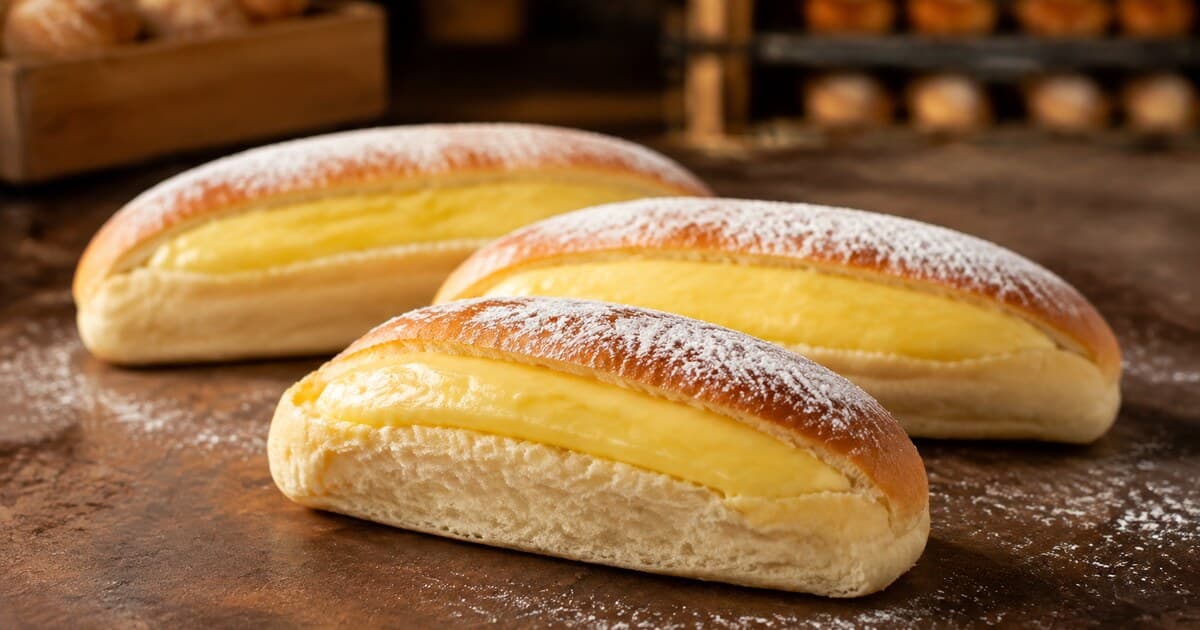
The Dutch bakery classic: a long, soft milk bun that is baked first, split only after cooling and generously piped with thick vanilla pastry cream.
The complete formula
Ten Dutch custard buns
Starting point: 10 buns at 125 g each, made from about 79 g of bread dough and 46 g of pastry cream per bun.Active preparation: about 40 min · Baking: 12–14 min · Cream chills for at least 2 hours; first rise 60–90 min and final proof 45–75 min.
- Bread flour
- 100%456 g
- Whole milk
- 55%251 g
- Salt
- 1.8%8.2 g
- Instant yeast
- 1.5%6.8 g
- Butter
- 8%37 g
- Sugar
- 8%37 g
- Vanilla pastry cream
- 100%456 g
Weights are rounded for weighing; their sum may differ slightly from the calculated total. Small additions stay in grams.
Vanilla pastry cream for ten buns
The total filling scales with the buns. This second formula divides that weight between milk, sugar, egg yolk, cornstarch and vanilla.- Whole milk
- 70%319 g
- Granulated sugar
- 14%64 g
- Egg yolk
- 8%37 g
- Cornstarch
- 7%32 g
- Vanilla
- 1%4.5 g
Weights are rounded for weighing; their sum may differ slightly from the calculated total. Small additions stay in grams.
A tender crumb with enough cream for every bite
The dough stays light and soft; the filling is thick enough to sit neatly along the split.Whole milk
For a soft, fine crumb without turning the dough into heavy brioche.
Dough per bun
A generous elongated roll that still bakes up light.
Cream per bun
Clearly filled from end to end without becoming excessive.
Oven
Bake for about 12–14 minutes, until lightly golden.
What makes this a Dutch custard bun
In the Dutch version, the custard is not baked inside the dough. First bake a soft white roll, cool it completely, split the top and pipe in the pastry cream afterward.
The main formula counts the finished pastry cream at 100% of the flour weight. That means a target of 125 grams really is about 125 grams per filled bun.
The separate filling formula uses percentages of the pastry-cream weight: 70% milk, 14% sugar, 8% egg yolk, 7% cornstarch and 1% vanilla. The filling therefore scales cleanly with the batch.
Make the cream first, bake the buns second, fill only when cold
The amounts below make 10 custard buns of about 125 g / 4.4 oz. Make the cream first: it needs at least 2 hours to chill, and the baked buns must be completely cold before filling.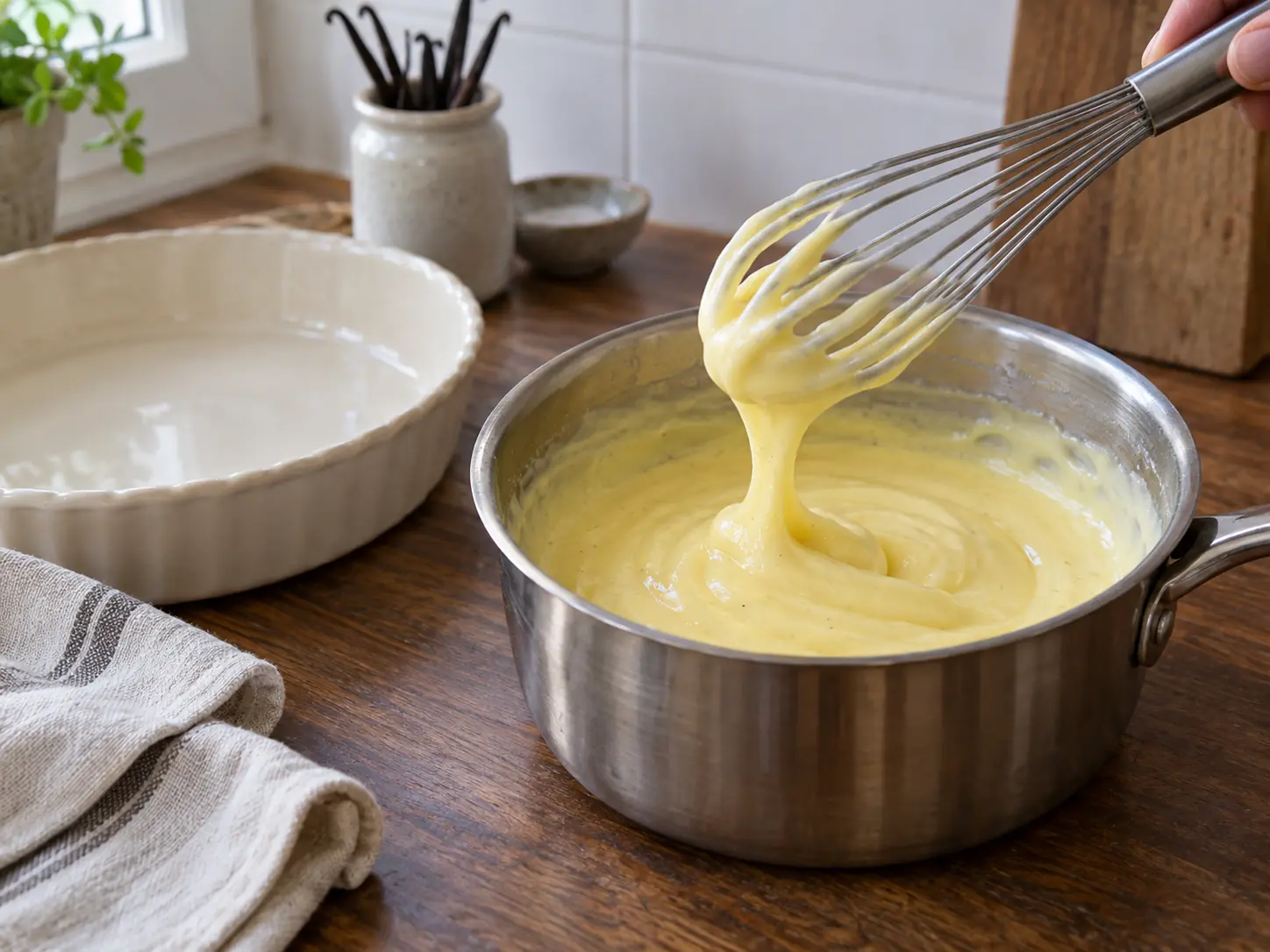
Cook the pastry cream
For ten buns use 319 g / 11.3 oz whole milk, 63.8 g / 2.3 oz sugar, 36.5 g / 1.3 oz egg yolk, 31.9 g / 1.1 oz cornstarch and 4.5 g vanilla: 70/14/8/7/1% of the total cream weight. 1. Whisk the yolk, sugar, cornstarch and about 50 g / 1.8 oz cold milk until lump-free. 2. Heat the remaining milk with the vanilla until steaming and almost simmering. 3. Whisk half the hot milk into the egg mixture, then return everything to the pan. 4. Bring to a boil over medium-low heat while whisking and cook for 60–90 seconds from the first bubbles, until the whisk leaves a clear trail.
The whisk leaves a trail that remains visible for a moment.
Chill the cream quickly
1. Immediately spread the hot cream in a shallow dish in a layer no deeper than 2 centimetres. 2. Cover the surface directly with film to prevent a skin. 3. Pre-cool for 15–20 minutes in a cold-water or ice bath, then refrigerate for at least 2 hours. 4. Whisk briefly just before filling; the cream must be completely cold, firm and pipeable.
Mix and knead
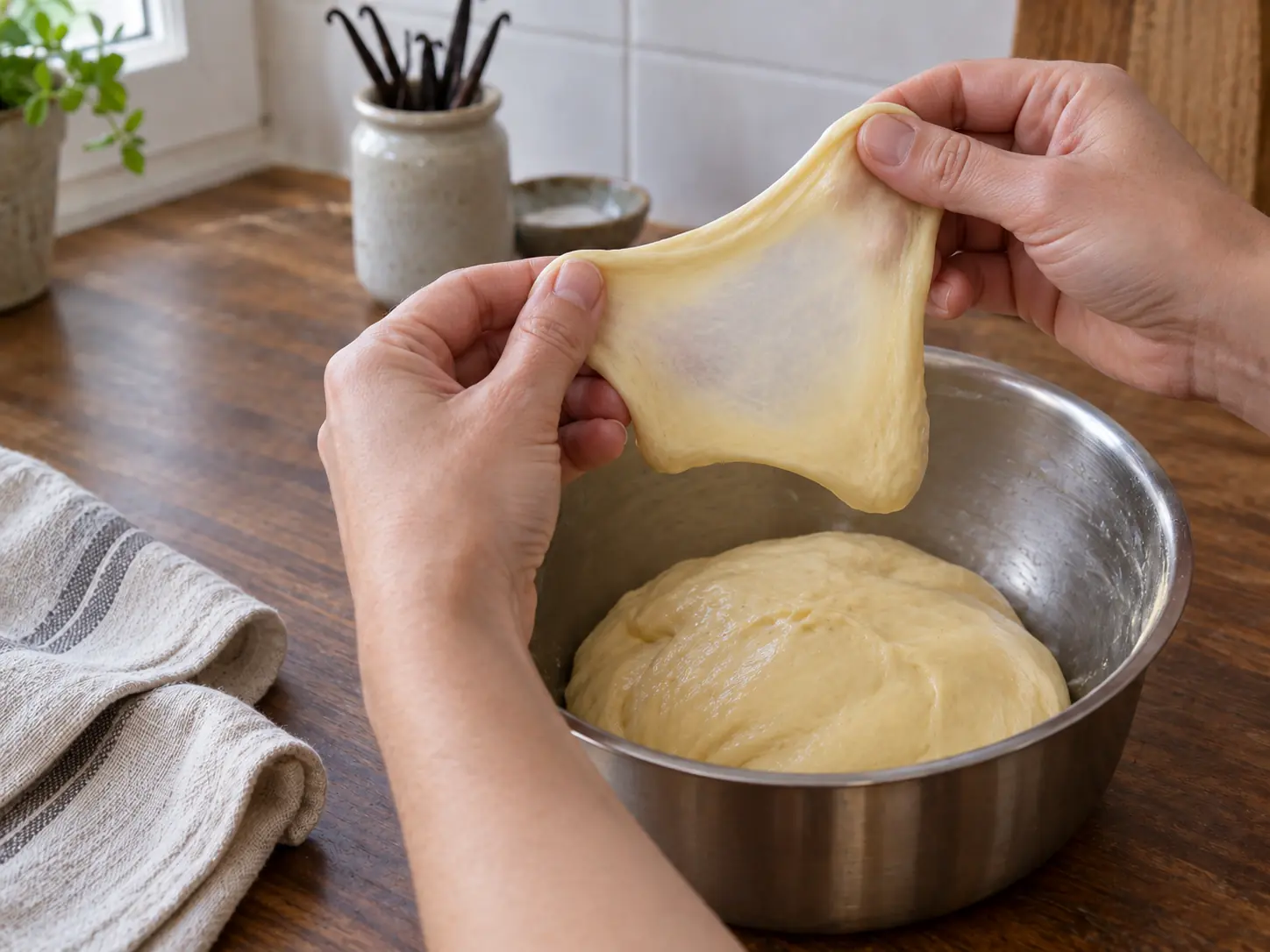
Use 456 g / 16.1 oz bread flour, 251 g / 8.9 oz whole milk, 6.8 g instant yeast, 36.5 g / 1.3 oz sugar, 8.2 g salt and 36.5 g / 1.3 oz softened butter. Bring the milk to 22–24 °C / 72–75 °F and stir in the yeast and sugar. Add the flour and mix for 3 minutes. Add the salt and knead for 4 minutes. Work in the butter in three additions and knead for another 5–8 minutes, until smooth, elastic and able to form a thin windowpane. Keep the dough below 26 °C / 79 °F.
Stretch a small piece thinly; the windowpane should remain intact.
Let the dough rise
Place in a lightly oiled bowl, cover and rise for 60–90 minutes at about 24–25 °C / 75–77 °F. It is ready when 60–75% larger, lighter and springy; this enriched dough does not need to double fully. If it still feels slack after 45 minutes, give it one gentle fold.
Divide and shape long
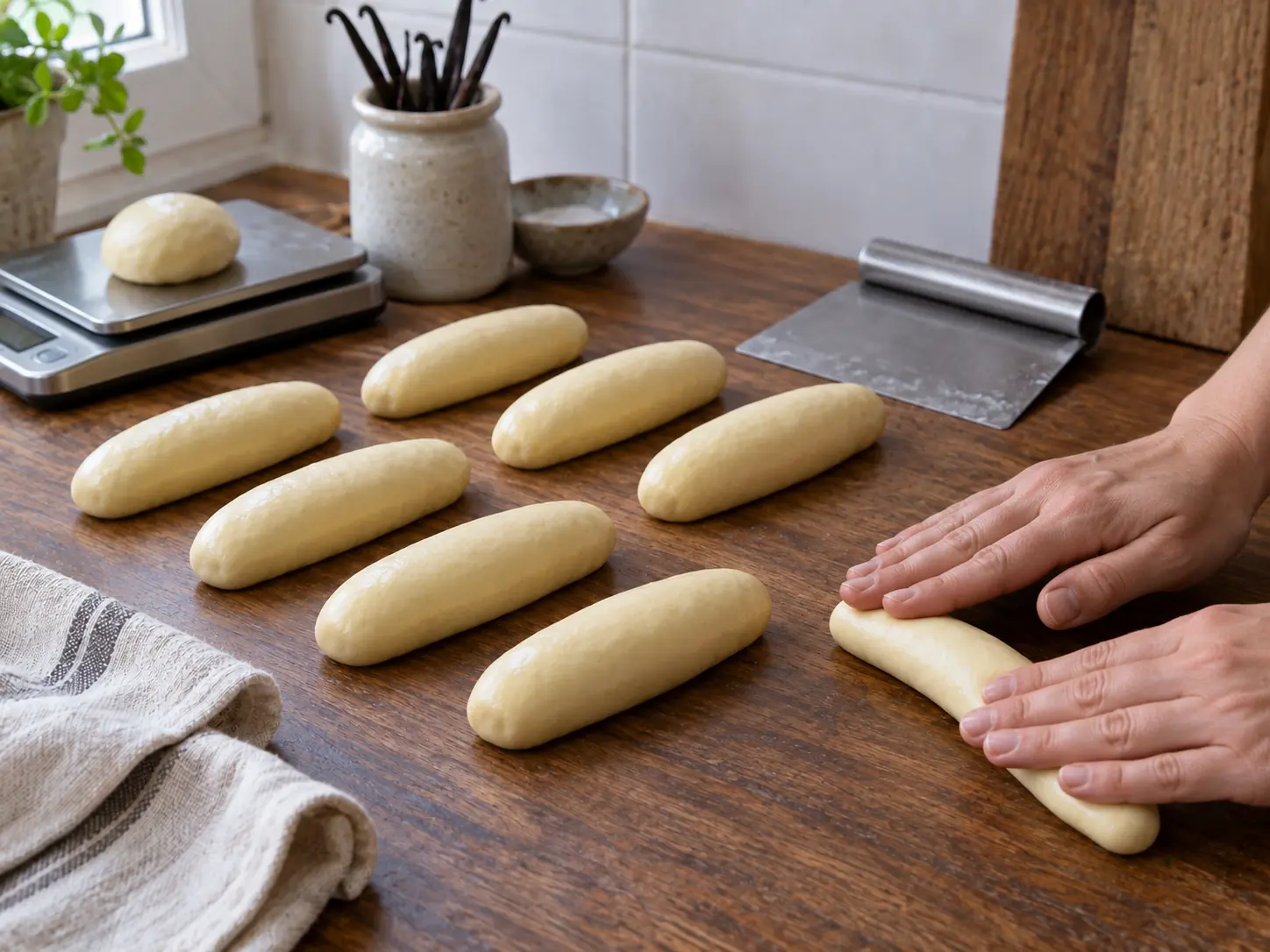
Divide into 10 pieces of about 79 g / 2.8 oz. Round each loosely, cover and rest for 10 minutes. Press gently flat, then roll from the center into an even bun about 13 cm / 5 in long. Place seam-side down with at least 5 cm / 2 in between buns on the tray.
Work evenly: equal in weight, smooth and the same thickness from end to end.
Proof and bake
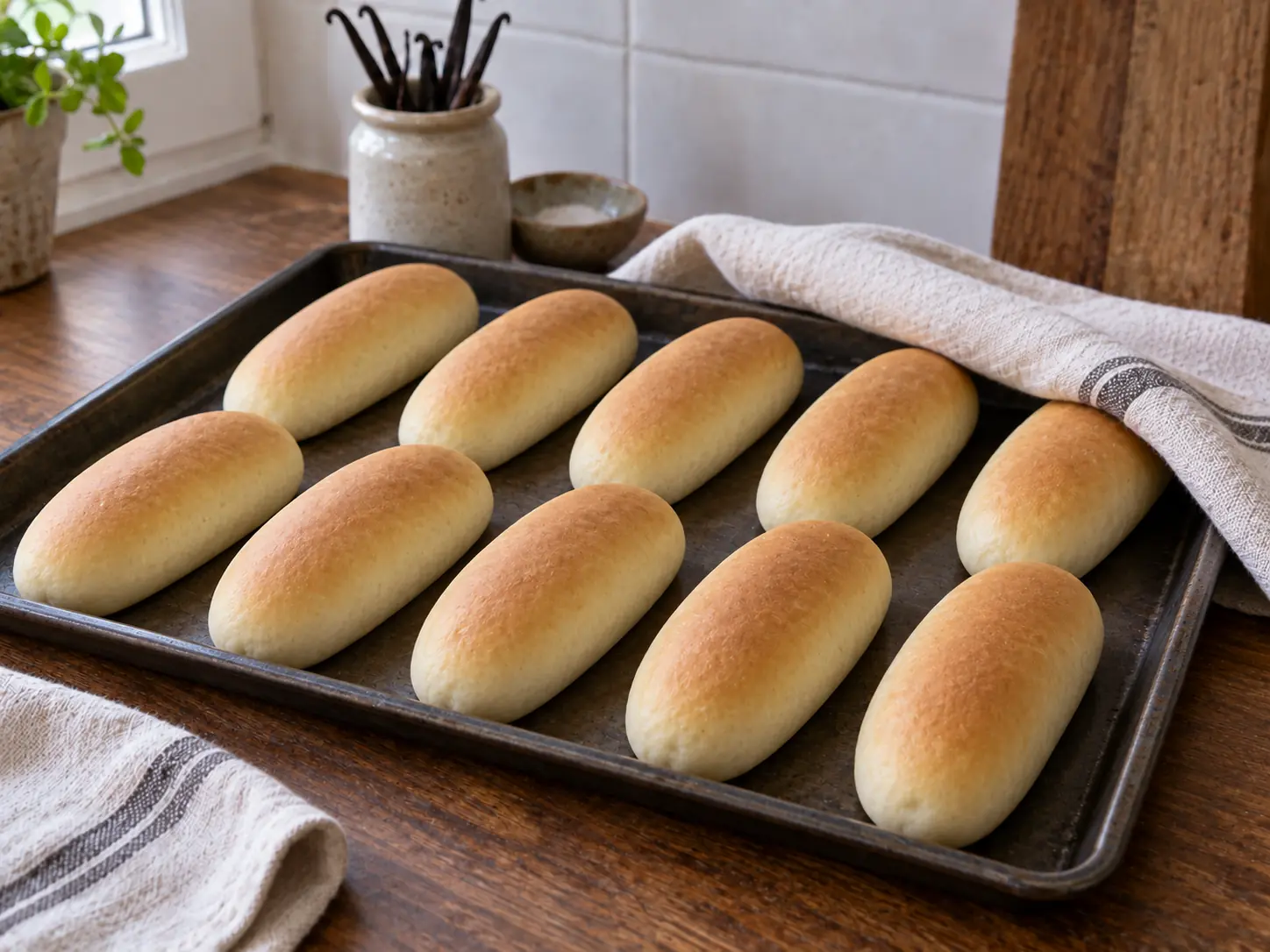
Cover and proof for 45–75 minutes at 24–26 °C / 75–79 °F, until clearly larger and a light fingertip dent returns slowly. Preheat for at least 30 minutes to 210 °C / 410 °F conventional or 190 °C / 375 °F fan. Brush lightly with milk or beaten egg and bake on the middle rack for 12–14 minutes. Cool on a rack under a clean towel for at least 45 minutes.
Remove them when lightly golden; baking them dark makes them drier.
Split, fill and dust
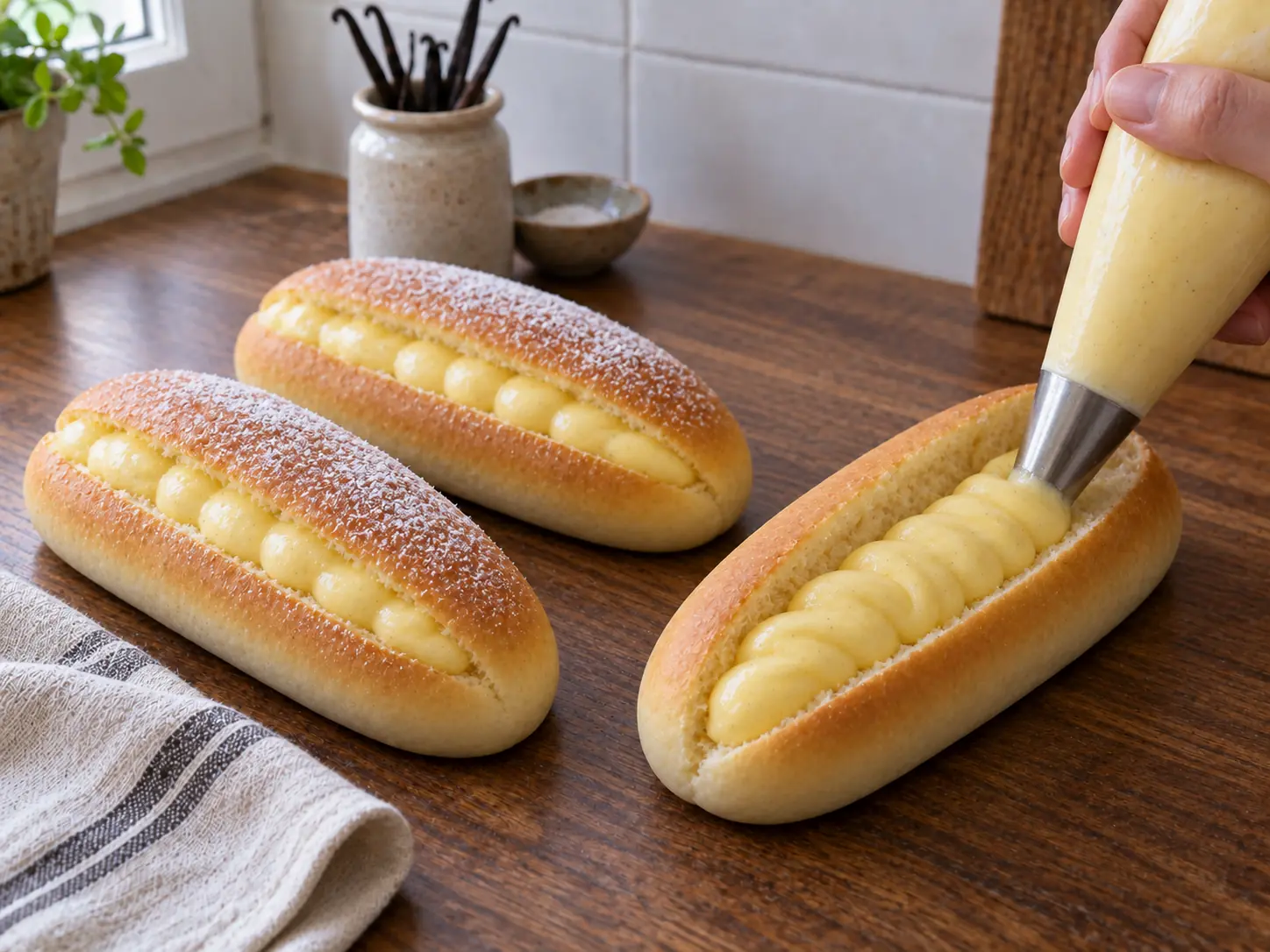
Whisk the cold cream briefly and transfer it to a piping bag with a 12–15 mm / ½ in opening. Cut each cold bun lengthwise from the top without cutting through the base. Pipe about 46 g / 1.6 oz of pastry cream from end to end and dust lightly with confectioners' sugar.
Do not cut through the base; pipe the cream from end to end.
Problems with the bun and cream filling
The buns turn dry
Do not bake them dark. Remove them when lightly golden and cool under a clean towel.
The cream runs out
Cook it until properly thick and chill it completely. Warm pastry cream always appears looser.
The buns tear while splitting
Cool them fully and use a small serrated knife. Cut deeply enough to fill, but not through the base.
The filling sits only in the middle
Use a piping bag and fill the full length in one steady pass, from end to end.
Frequently asked questions
Is vanilla pudding the same as pastry cream?
Not quite. Pastry cream is a firm custard made with egg yolk and starch, designed to remain smooth and pipeable when cold.
Can I use custard powder?
Yes. Make it thick enough to pipe and keep the calculated total filling weight. Its flavor and texture will differ from egg-yolk pastry cream.
Can I make the cream a day ahead?
Yes. Cover the surface, chill it quickly and refrigerate well covered for up to one day. Whisk briefly before filling.
Can Dutch custard buns be frozen?
Freeze the unfilled buns if possible. Pastry cream can become watery or grainy after thawing.